
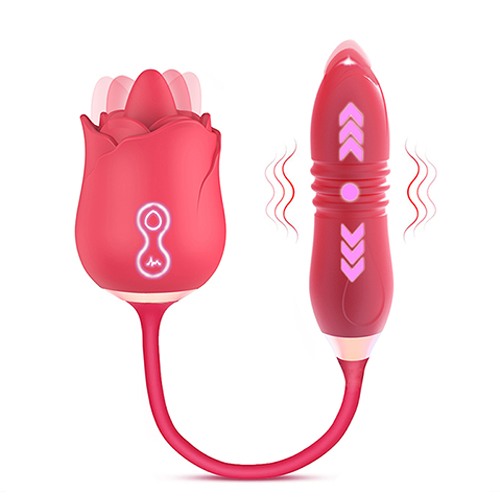

HIJOY 20112 connects a rose-shaped tongue head to a second, elongated section through a flexible link. The item text concentrates on tongue motion, but its detail illustrations also label thrust and vibration at the elongated end. Those two descriptions matter when writing a product brief: the tongue head has an illustrated control instruction, while the second section's operating sequence still needs a model-specific manual.
Separate component dimensions from the assembly's straightened length.
The size artwork supplies metric and approximate inch labels. The 410 mm figure is drawn along the straightened linked assembly; it is not the length of either working section or a guaranteed usable insertion dimension.
| Parameter | Published specification | What to confirm |
|---|---|---|
| Straightened assembly | 410 mm illustrated overall length [4] | The source straightens the flexible link for this view. Package-envelope dimensions and minimum bend radius are not specified. |
| Elongated section | 121 mm length; 33 mm width label [4] | These are drawing labels, with no tolerances or separate usable-length declaration. The artwork does not specify travel distance. |
| Rose section | 87 mm height; 55 mm width label [4] | The labels describe the pictured head's envelope, not the tongue's stroke or contact opening. |
| Charge and endurance | About 120 min charging; about 1 h of tongue motion [1] [6] | The text explicitly limits use time to single tongue-licking operation. The charge graphic's broader one-hour headline does not establish simultaneous-function endurance. |
| Charging interface | USB lead with two-contact connection illustrated at the rose head [6] | Obtain the supplied lead, contact geometry, source rating and indicator instructions. Battery capacity is not stated. |
| Water exposure | Running-water washing advertised; no IP code supplied [5] | The washing artwork is a supplier statement, not a verified immersion rating. It does not define cleaning agents, exposure limits or drying before charging. |
Give the two ends separate lines in the function specification.
The product text and tongue graphic establish tongue motion; they do not describe an air-pressure or suction mechanism. Keep 20112 out of a suction filter unless the supplier provides a model-linked explanation of that additional function. [1] [2] [3] [5]
| Function | What the model source actually describes | What the manual must resolve |
|---|---|---|
| Rose tongue | Ten licking modes; the operation graphic assigns a two-second on/off hold to the power symbol and short presses to the waveform control after startup. | Startup mode, wrap-around, stop behavior and whether other functions continue after this head stops. |
| Elongated end | Its separate graphic is headed ten thrust-and-vibration modes. | Where it is controlled, whether thrust and vibration separate, and the mechanism's stopped position and travel. |
| Combined operation | The source shows both ends in one linked device. | Allowed combinations and their runtime. Two ten-count headings do not prove one hundred independent combinations. |
The flexible link changes how the product is held, stored and cleaned.
Use an assembly drawing for the link
Ask for the connecting length, permitted bend range and strain-relief details at both ends. The bent display photograph establishes the linked layout, but it does not say the link can be stretched or used to pull the two housings apart.
Distinguish the motion claim from a measured stroke
The title uses stretching terminology and the second-section graphic uses thrust arrows. A sourcing comparison needs actual displacement and the condition under which it is measured. Do not substitute the 121 mm housing length for stroke length.
Write care instructions for the whole connected unit
A cleaning brief should cover the rose's petal gaps, elongated section, both link junctions and charging contacts. Request the model's permitted method and drying routine before repeating the washing headline on retail packaging.
Questions that change a 20112 order.
Can the one-hour figure be used for both ends running together?
The item text specifies single tongue-licking use. Obtain a separate duration with the elongated end's functions active and state that configuration alongside the result.
Does the linked design prove wireless or app control?
No remote or application is identified in the reviewed model text or eight detail graphics. The supplied control instruction concerns buttons on the rose head.
What remains missing for a commercial specification?
The reviewed item does not give material formulation, mass, battery capacity, model-specific MOQ or a complete manual for the elongated end. Request those for item 20112 rather than borrow values from another rose model.
Sources and editorial review
QQIP Editorial retrieved the official HIJOY item and individually inspected its eight linked detail graphics on 9 October 2026. Metric drawing labels and control wording are attributed supplier statements. QQIP has not operated the unit, measured stroke, authenticated ingress results or established image reuse permission. No ratings, anatomical outcomes or approvals are inferred from promotional artwork.
- HIJOY — item 20112 ↗
Item number, tongue-mode text and single-function endurance.
- HIJOY — tongue-function graphic ↗
Ten tongue-licking modes. Promotional outcome wording is not adopted.
- HIJOY — thrust-and-vibration graphic ↗
Separate ten-mode heading for the elongated end; no measured stroke.
- HIJOY — linked assembly dimensions ↗
Straightened 410 mm assembly and 121/33/87/55 mm component labels.
- HIJOY — tongue control and washing graphic ↗
Two-second power hold, short-press licking selection and washing claim without an IP code.
- HIJOY — charging graphic ↗
Two-contact charging illustration and approximately two-hour charge headline.