
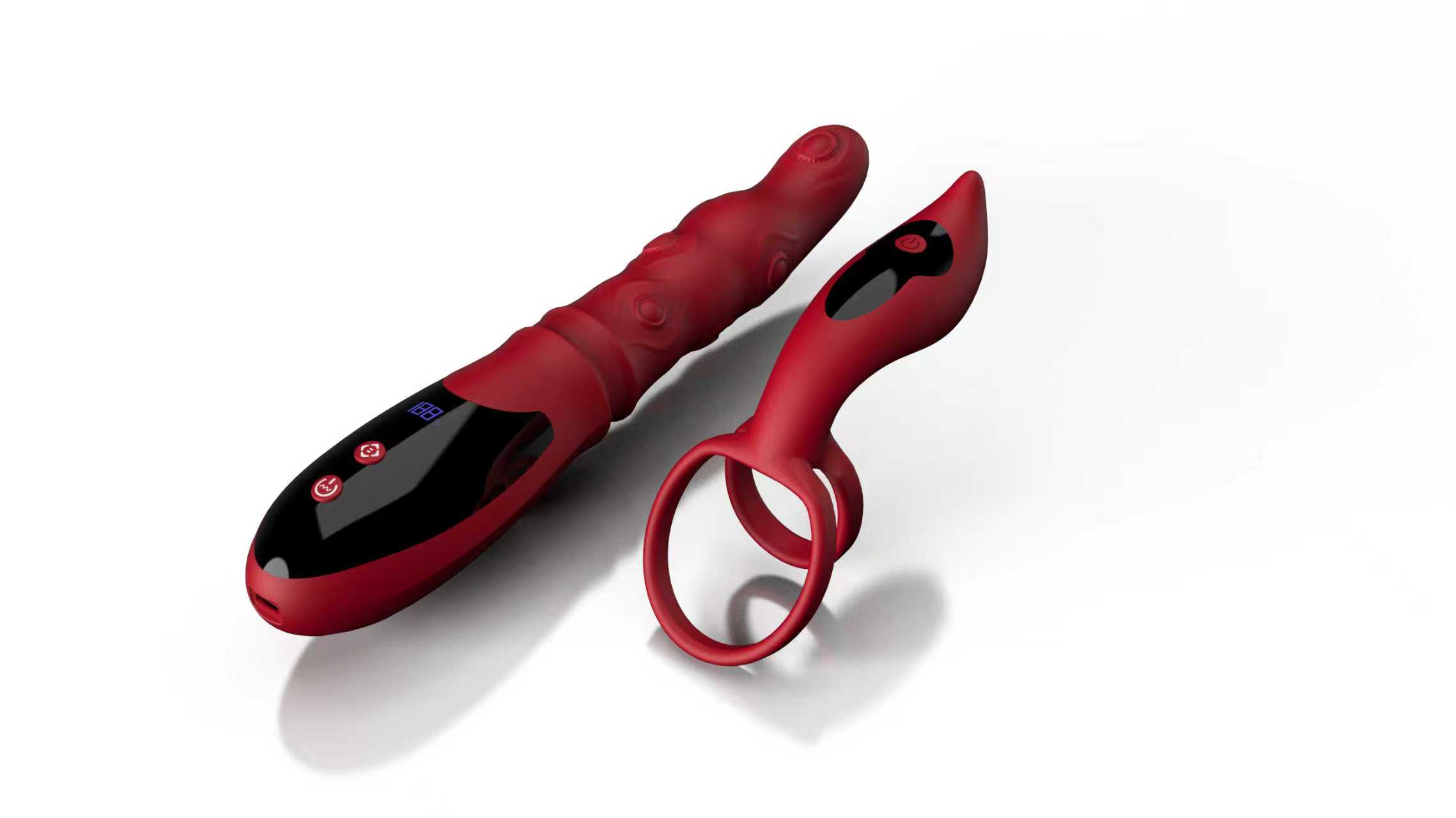

LG-1336A combines a long burgundy main body with a smaller powered unit held beside it by a removable ring carrier. Taking that side unit off does not turn it into a passive accessory: its own power key selects ten vibration modes. The main body has a separate power/vibration key and a mechanical-action key. LUOGE’s detail sheet labels an APP edition, so the order should identify that revision as well as the two powered components.
Keep the illustrated edition and component basis visible.
These values come from the graphics linked inside the LG-1336A item. The parameter graphic labels an APP version. They should not silently become specifications for every similarly named order revision.
| Parameter | Published specification | What to confirm |
|---|---|---|
| Illustrated geometry | Drawing labels: 260 mm overall, 135 mm main section, 93 mm side component [2] | The dotted dimension paths follow the pictured contours. They are not a defined straight-line packaging envelope or a recommended use depth. |
| Cross-section labels | 30 mm and 36 mm marked at illustrated main-body sections [2] | The endpoints identify different locations; no circular-section diameter, manufacturing tolerance or universal fit range is established. |
| Material and water claim | Silicone + ABS; IPX6 in APP-edition graphic [2] [4] | A formulation or model-linked ingress report was not authenticated. Cleaning artwork tells users to avoid the charging openings. |
| Charging arrangement | Type-C; charging illustrated on both powered parts [4] | The image shows two ports, not one charging circuit shared by both components. Supply ratings and cell capacities are not supplied. |
| Duration references | 90 min charging; 60 min use [2] [4] | The graphics do not assign tested conditions or separate duration figures to the main body and detachable unit. |
| Charging indicator | Flashes during charging; steady when full [2] | Confirm this indication on both supplied parts and retain any version-specific difference in the manual. |
The side unit has its own power key.
Original Chinese key map: the separate unit and main power keys use a 1.5-second hold; short presses select ten and nine vibration modes respectively. The mechanical key is used after main power-on; its 1.5-second hold stops that function. English interpretation follows below. [3]
View the original source illustration ↗Read each control against the component it operates.
The separate function graphic labels seven mechanical selections, nine main vibration selections and ten detachable vibration selections. The 26-count headline sums the groups; it does not establish 26 steady speeds or every possible combined state. [3] [5]
| Component or function | Published instruction | Still to confirm |
|---|---|---|
| Detachable unit | Hold its power button 1.5 seconds for on/off; short presses cycle ten vibration modes. | Startup selection, wrap-around and any retained setting. |
| Main vibration | Hold main power 1.5 seconds for on/off; short presses cycle nine main-body modes. | Whether restart restores a selection and whether main shutdown stops every other main function. |
| Mechanical action | After powering on the main body, short presses cycle the mechanical-action levels; a 1.5-second hold disables that action. | Complete seven-state timing and the mechanism's stopped position. |
The detachable unit needs its own order and replacement identity.
Specify what accompanies the main device
Ask for the main body, powered detachable part, ring carrier, charging leads and instructions as separately identified components. Do not assume a second main body or a replacement unit is included merely because the product is shown in several arrangements.
Define attachment and permitted adjustment
The supplier shows the side unit mounted beside the main section and detached for use on its ring carrier. Obtain the actual removal, seating and adjustment instruction. Ring geometry, fit range, component retention and replacement interchangeability are not established by the illustration.
Keep mechanical movement distinct from axial stroke
The graphics describe multiple pulsing points and a 15-degree tip motion. They do not give an axial travel dimension or a measured loaded output. Do not turn those descriptions into a thrust-stroke filter or an anatomical outcome guarantee.
The dimension sheet names an APP edition.
Original parameter sheet: 260/135/93 mm contour paths and 30/36 mm section labels; silicone + ABS, IPX6, Type-C, 90-minute charge and 60-minute use. Those durations have no separate main/side-unit workload basis. The final field explicitly says APP edition. [2]
View the original source illustration ↗Approve the charge and cleaning routine for each powered part.
Identify both ports and their leads
The charge graphic depicts Type-C leads at the main body and detachable part. Request the actual included quantity, approved supply ratings, charge indication and any port closure. USB-C geometry alone does not establish power-negotiation support.
Assign each duration to a test case
Ask whether the 90-minute charge and 60-minute use labels describe one part, both parts or a selected configuration. Record the active functions and endpoint for each component; do not advertise the same duration for all three function groups without that basis.
Resolve exposure at the openings
The washing graphic explicitly says to avoid the charging ports. Have the supplier reconcile that instruction with the IPX6 claim for the ordered assembly and give its drying-before-charging routine. Neither statement supplies permission for immersion.
An APP-edition graphic is not a tested phone-compatibility list.
The supplier advertises remote APP interaction and calls the parameter-sheet version an APP edition. The reviewed graphics do not identify the application, minimum operating-system versions, pairing routine or supported control groups. Obtain those details for the exact ordered revision rather than assigning a generic brand application. [2]
Include interruption behavior in the version brief
Ask what remains locally controllable when the phone disconnects, how a remote session is ended and what state resumes after restart. Those are unanswered requirements prompted by the advertised remote function, not capabilities demonstrated by QQIP.
Resolve the configuration before comparing offers.
Can the detachable unit be treated as an unpowered ring?
No. The supplier key map gives it a separate power button and ten vibration selections. Specify that powered part, its carrier and its charge lead separately; the source does not establish compatibility with replacements from another revision.
Does the illustrated APP edition establish control of all three function groups from a phone?
The artwork advertises APP interaction but supplies no app identity or function-by-function phone mapping. The local keys have a published map; phone control, supported operating systems and disconnect behavior require confirmation for the ordered edition.
Does the 60-minute use label cover both powered parts together?
The sheet does not assign that label to separate parts or state the active functions. Do not promise simultaneous endurance from the figure; request separate main and detachable-unit figures with their test conditions.
Sources and editorial review
QQIP Editorial reviewed the LUOGE LG-1336A item and its thirteen linked detail graphics on 9 October 2026. The model text identifies LG-1336A and burgundy color; the parameter artwork labels an APP edition. The local-control instructions above translate that artwork. QQIP has not tested the mechanical action, phone connection, durations or water resistance. Order-revision linkage and component-specific figures remain unconfirmed.
- LUOGE — LG-1336A model item ↗
Model identity, burgundy color and linked detail sequence. Original item retrieved over HTTP; HTTPS certificate validation failed and was not bypassed.
- LUOGE — APP-edition parameter graphic ↗
Illustrated dimension paths, APP version label, materials, Type-C, duration and charging indicator. Supplier-hosted HTTP graphic.
- LUOGE — component operation graphic ↗
Separate and main power buttons, 1.5-second holds and mechanical-action precondition. Supplier-hosted HTTP graphic.
- LUOGE — two-port charging and cleaning graphic ↗
Two depicted Type-C charge points, duration labels and avoid-charging-opening cleaning warning. Supplier-hosted HTTP graphic.
- LUOGE — three function-group counts ↗
Seven mechanical, nine main vibration and ten detachable vibration selections. Supplier-hosted HTTP graphic.