
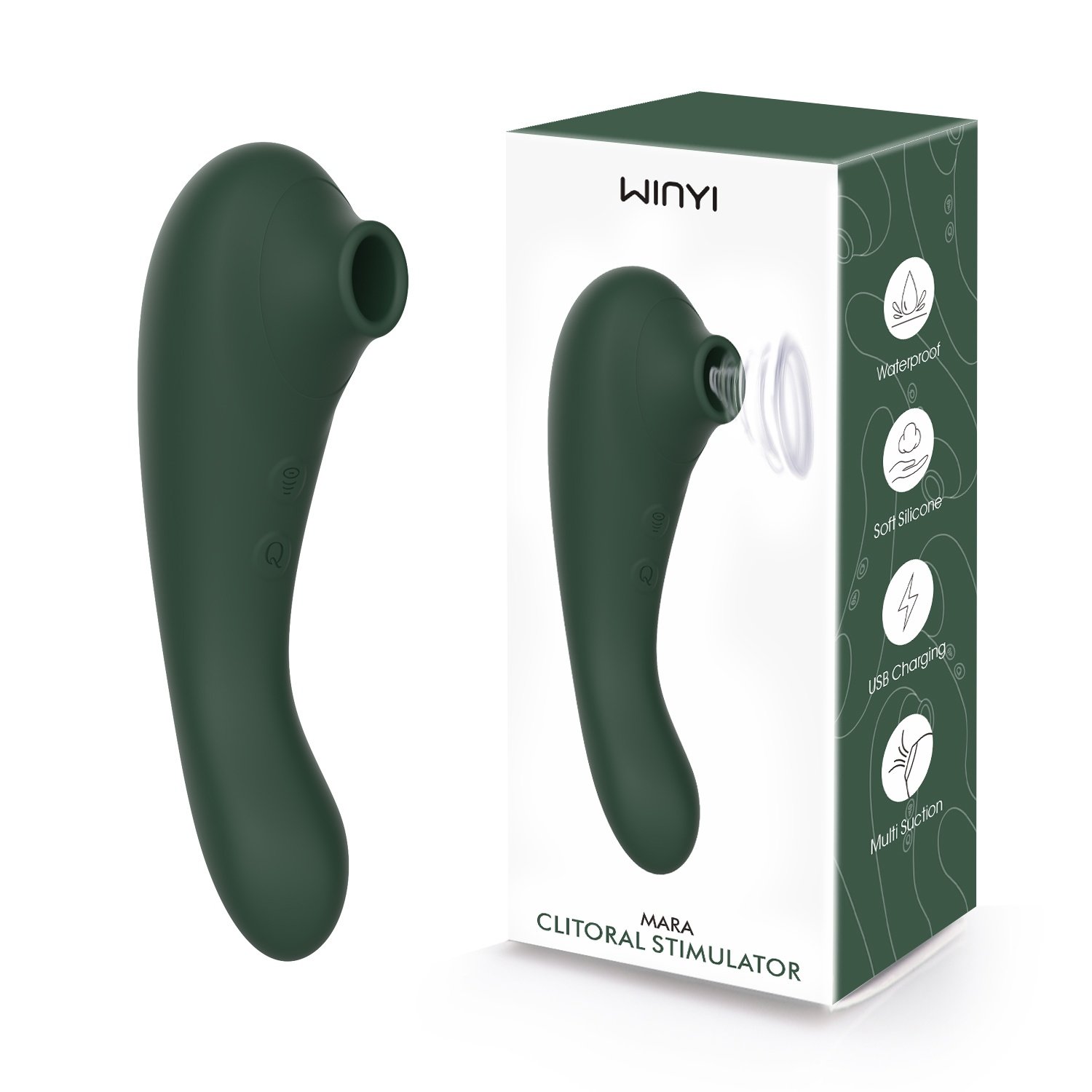
WY0635 Whale combines air-pulse suction with vibration in a curved rechargeable device. Its two controls let a buyer describe more than one operating sequence, but the published runtime does not state which sequence was running. The useful sourcing task is to define the desired suction/vibration combinations and burst behavior, then obtain evidence for those states on the actual sample.
- Control groups
- Separate suction and vibration buttons [1]
- Suction choices
- Ten modes: three steady, seven variable [1]
- Vibration choices
- Ten modes and a burst selection [1]
- Connector
- Pin charging, 15 mm pin listed [1]
This review concerns WY0635. A general WINYI report or a material description does not by itself establish the evidence scope for this model's contact parts, cell or enclosure.
Attach the figures to the operating state they describe.
The manufacturer publishes these starting values. For the two-function design, an operating-state definition is essential when requesting sample results or a production commitment.
| Parameter | Published specification | What to confirm |
|---|---|---|
| Body | Approx. 161 × 42 × 59 mm; 131 g [1] | Ask for axis-labelled dimensions and opening geometry. The outer shape does not specify the contact interface. |
| Battery and input | 500 mAh; rated 3.7 V; operating current ≤310 mA; charging 5 V / 340 mA [1] | Confirm cell identity and correct charging set for the quoted revision. A capacity figure cannot determine combined-function endurance. The ≤310 mA operating-current ceiling is also a supplier figure; the page does not say which suction and vibration settings it was measured with. |
| Times | Discharge ≥70 min; charge ≤120 min [1] | Ask which functions and settings were active and how the run ended. Do not extend a result from a single function to a combined state. |
| Cable | USB pin-type cable; 15 mm pin [1] | Confirm connector diameter, insertion depth, cable part and approved port arrangement. Pin length alone is not a complete compatibility specification. |
| Exterior wording | Supplier describes food-grade silicone [1] | Identify the formulation, contact parts and underlying records. The description is not an authenticated suitability assessment by QQIP. |
| Water and sound | IPX6; ≤55 dB at 30 cm claimed [1] | Request the matching finished-assembly evidence and full sound setup, including the selected action combination. |
Write the action combination into the approval record.
The official operation notes describe separate on/off controls and a double-press vibration burst selection. They do not specify every resulting combination or exit state. The following are questions to resolve on the current revision, not observations from a QQIP test. [1]
| State | What the source describes | What the sample review must settle |
|---|---|---|
| Suction alone | Separate suction on/off and ten selections | Initial state, cycling order and behavior with vibration off |
| Vibration alone | Separate vibration on/off and ten selections | Initial state, selection sequence and stop behavior |
| Both active | Both functions are advertised | Supported combinations, interaction and output under combined load |
| Burst selection | Double press while vibration is active | Duration or holding behavior, exit selection and effect on any running suction |
| Low battery | Rapid indication followed by shutdown | Which actions stop and what operating state defines usable runtime |
Decide what the burst control should mean to your range.
Do not silently make it an eleventh ordinary pattern
The catalog separates burst from the ten vibration modes. Ask whether it is momentary, latched or time-limited, and how a user returns to the previous state. Keep the agreed behavior in the instruction proof rather than adding a mode count that the sample has not established.
Approve the interaction that users will encounter
If your product proposition involves suction and burst together, request that exact sample demonstration and operating result. Determine what happens when one button is switched off while the other function is active. A statement that both functions exist does not settle how every interaction behaves.
Choose one defined combined-load case for the runtime discussion.
Name the actions and selections
Specify the suction and vibration states required by the brief, including whether burst is involved. Ask the supplier to identify the states used for its published discharge figure. A simple count of settings cannot predict their electrical load.
Agree the output and endpoint
Request the fixture or load, start-of-test charge and stopping criterion. If the purpose is to sustain both functions, define how reduced output is recorded before automatic stop. Keep the results tied to that sample and revision.
Keep charging separate
Confirm the entire pin/port drawing and supplied lead before timing a charge. The active-runtime case does not establish a compatible replacement cable or a water-exposure procedure around the charging port.
A list of document names needs a model match.
The model table lists CE, RoHS and UN38.3. The linked general documentation page itself states that reports are limited to their tested model, material, component or family. No matching original report has been authenticated in this review. [1] [2]
Identify what each file covers
Request the actual document, applicant, report identifier, tested model/revision and applicable component. Keep cell transport evidence separate from contact-material evidence. A page listing these names does not show that one document covers all of those questions.
Resolve the silicone claim at the contact part
Ask which formulation and finished part the supplier describes, and what use conditions its records support. Do not convert the phrase food-grade into a medical-grade or universal body-contact approval claim.
Three points to settle in the WY0635 quotation.
Does the published runtime apply with suction and vibration running together?
The online conditions do not establish this. Ask for the specific combination and test method required by your brief.
Can I substitute another pin cable because its pin is also 15 mm long?
Not on length alone. Connector diameter, electrical requirements, insertion relationship and the approved lead must also match.
Does the general customization minimum include a new opening or control sequence?
That scope has not been established. Separate changes to geometry or control logic from the advertised color/logo order and request revised development terms.
Sources and editorial review
QQIP Editorial independently reviewed the WY0635 page and its linked general documentation page on 8 October 2026. Values and operating descriptions are supplier declarations; proposed state checks are editorial analysis. QQIP has not operated a sample, authenticated a report, confirmed a current quotation or established the test load behind published endurance and sound figures. The exact combined and burst behavior remains a sample-review question.
- WINYI — WY0635 Whale official model page ↗
Model values, two-button operation, burst description, material wording and advertised document names. Detailed operating conditions and matching reports remain unconfirmed.
- WINYI — general certification and documentation page ↗
Supplier explanation that reports apply to specified models/components. General document availability is not authentication of WY0635 evidence.