
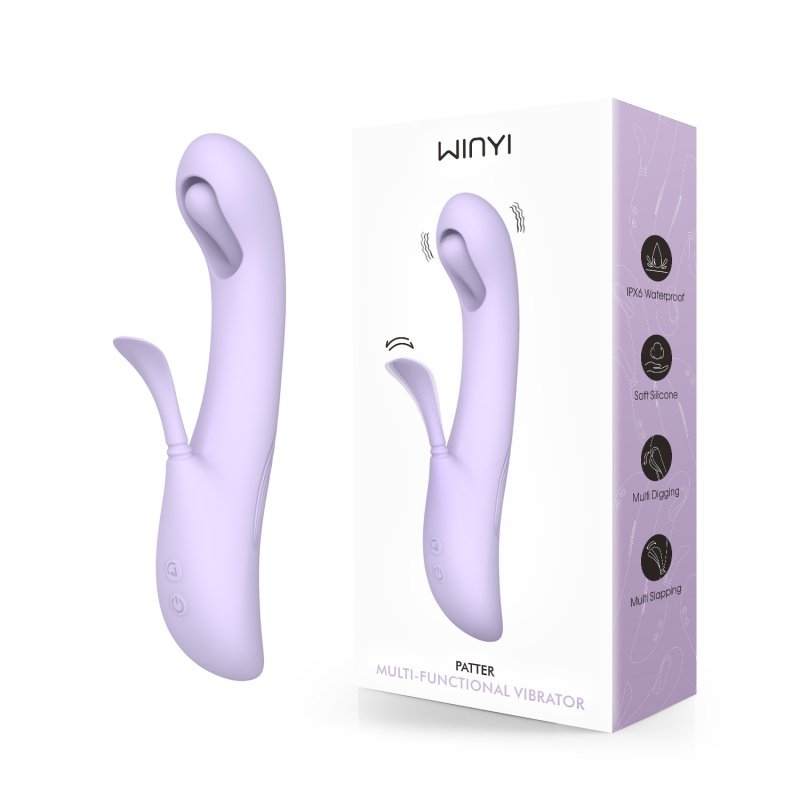
WY0773 places digging, vibration and a separately controlled flapping action in one body. The purchasing distinction is not a multiplied mode count: the official instructions describe pause and automatic head reset, which need their own acceptance decisions. Define the movement after switching or stopping before discussing endurance under a combined workload.
- Main functions
- Digging, vibration and flapping [1]
- Control groups
- Main button + separate flapping button [1]
- Battery
- 800 mAh supplier declaration [1]
- Sourcing focus
- State transitions and combined operation
The manufacturer uses 'digging' and 'bird flapping' as mechanism descriptions. This page does not infer stroke length, delivered force or motion frequency from those labels.
A motion count is only the beginning of the specification.
Supplier-published values establish the catalog reference. They leave important questions about movement, combined load and test conditions open. Use the interpretation column to request the missing evidence for the sample you actually approve.
| Parameter | Published specification | What to confirm |
|---|---|---|
| Body | Approx. 222 × 86 × 44 mm; 190 g [1] | Request the drawing with axis definitions, moving-part envelope and tolerances. Exterior dimensions do not specify the range of travel. |
| Functions | Three digging speeds, ten vibration modes, ten flapping modes [1] | Confirm how each selection interacts with the others. The counts do not establish every possible combination or the output in each state. |
| Contact material | Silicone [1] | Identify the actual contact components and material formulation; request the relevant records for the target use and destination. |
| Cell | 102040 lithium battery; 800 mAh [1] | Match the installed cell and protective circuitry to the accepted production revision and applicable shipping documents. |
| Time declarations | Use ≥45 min; charge ≤120 min [1] | The online sheet does not state which actions run for the runtime figure. Request the action combination, starting charge and end condition. |
| Charging | Magnetic USB cable; 7 mm spacing; 5 V; 850 ±50 mA [1] | Spacing does not establish polarity or interchangeability. Confirm the complete connector arrangement and supplier-approved cable. |
| Enclosure and sound | IPX6; ≤60 dB at 30 cm [1] | Obtain the matching enclosure report and complete sound-test setup. Do not rewrite this water-resistance claim as an immersion specification. |
| Motor references | 242 rpm, 950 rpm and 15,000 rpm listed [1] | The sheet does not map these values to measured finished-device movement. Request the mechanism mapping; do not convert them into stroke rates, amplitude or delivered intensity. |
Keep pause and automatic head reset as separate decisions.
The official instructions describe a main control for digging and vibration, a separate flapping control, pause operation and automatic head reset. Ask for the exact instruction revision shipped with your sample and verify the states below against it. [1]
| State to review | Record on the sample | Why it matters |
|---|---|---|
| Start and main selection | Starting actions, selection sequence and indicator behavior | The retail instructions must match what the first interaction actually does |
| Separate flapping selection | How it starts, changes state and interacts with the main selection | A separate button does not by itself describe independent combined operation |
| Pause and resume | Which action stops, which continues and which state returns | Buyers need a clear distinction between pausing one action and turning off the device |
| Shutdown and reset | Movement after shutdown, final position and abnormal interruption behavior | Automatic reset is a movement to document, not simply an extra selling point |
The head may move after the stop command. Specify that envelope.
The supplier describes automatic head reset at shutdown. That description does not define the travel envelope, final position or behavior if power is interrupted before reset finishes. These are open sample questions, not faults established by this review. [1]
Ask for the mechanism axes
Request an axis-labelled drawing of digging and reset movement, with travel limits and reference positions. A motor rpm entry is not the frequency or travel of the finished mechanism. Keep the drawing with the accepted instruction sequence.
Distinguish pause from shutdown
Clarify whether the double-press pause stops one mechanism or all active actions, and whether reset occurs at that moment or only on shutdown. Review the sequence with the separate flapping control active, rather than treating a paused state as a powered-off state.
Resolve interrupted reset
Ask how the current revision behaves at low charge and after an interrupted reset. Agree the restart position and any required instruction. QQIP has not observed these cases on a physical sample.
Specify runtime under the workload you intend to claim.
Choose the operating combination first
A multi-action device can place different demands on its power system across states. Ask what was operating when the supplier's runtime figure was established. Write the required combination into your own sample brief rather than transferring a catalog time to every setting.
Define usable output and the stopping point
Agree whether a timed run ends at automatic shutdown, a low-battery indication or a stated output threshold. Ask what output variation is allowed over that period. A device that continues running is not automatically delivering the same movement throughout.
A new reset sequence is a development change.
Name the exact sequence to change
If the desired range needs a different pause, final head position or restart behavior, include that sequence in the development brief. The general color/logo minimum does not establish the terms for altering controller logic or mechanical travel.
Two conclusions the mode counts do not support.
Can I multiply the digging, vibration and flapping counts into a total number of combinations?
Not without the supported state matrix. Separate mode counts do not establish every combination or transition.
Does the published running time establish endurance with all actions active?
The published conditions do not settle that. Obtain the operating combination and ending criterion behind the figure, then agree the combined workload required by the brief.
Sources and editorial review
QQIP Editorial independently authored this review after reading the official WY0773 model page on 8 October 2026. Published specifications and order conditions remain supplier declarations. The state matrix and sample procedure are editorial procurement recommendations, not completed tests. QQIP has not authenticated supporting reports, obtained a binding quote or confirmed inventory. No movement frequency, travel or force has been inferred from motor references.
- WINYI — WY0773 official model page ↗
Model functions, control descriptions, listed dimensions, battery, charging, runtime, water/sound claims and general order FAQ. Missing output mapping, workload conditions and authenticated reports remain open.