
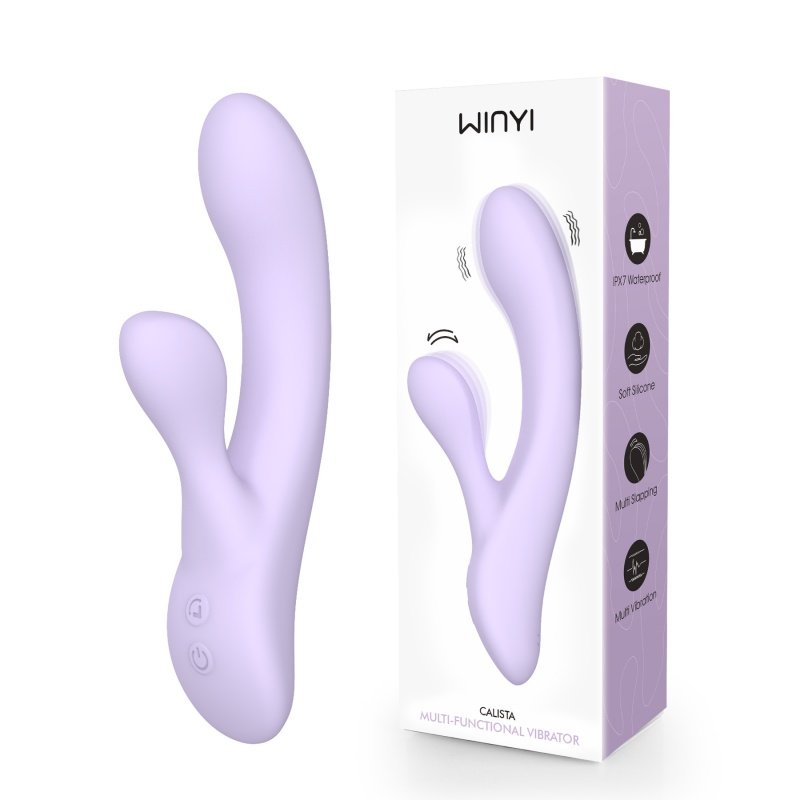

WY0782 adds a moving bird-shaped section to a vibrating wand head. Its unusual sourcing detail is an amplitude-setting window after shutdown: the manufacturer describes a ten-second period in which the bird button adjusts that setting. A buyer needs to know what position or travel is being selected, what remains stored and how the instruction distinguishes setup from normal use.
- Setup detail
- Amplitude adjustment within ten seconds after shutdown [1]
- Zone controls
- Separate double-press pause commands [1]
- Main head
- Three steady speeds plus seven patterns [1]
- Secondary section
- Three thrusting speeds and ten vibration modes [1]
This is a review of WY0782's published configuration. No physical movement, retention, sound or water test has been performed by QQIP.
Separate the output geometry from the motor references.
These are manufacturer-published values. The drawing and setting-retention questions below remain open; neither the size nor a motor speed defines the secondary section's travel.
| Parameter | Published specification | What to confirm |
|---|---|---|
| Envelope | Approx. 186 × 76 × 39 mm; 155 g [1] | Obtain the stationary and moving-section envelopes on labelled axes, including the selected amplitude. |
| Cell | 902030 / 500 mAh; rated 3.7 V [1] | This identifies a supplier cell reference, not the endurance of every combination of head and secondary actions. |
| Times | Run ≥45 min; charge ≤90 min [1] | Ask which zones, thrusting selection and amplitude were active for the running-time figure. |
| Lead and input | Magnetic USB; 3 mm contacts / 7 mm spacing; 5 V, 500 ±50 mA [1] | Match the actual cable and contact/polarity drawing. Contact spacing is not a universal lead-compatibility standard. |
| Motor references | N15 9,260 rpm; 030 8,000 rpm; N20 geared 165 rpm [1] | The page does not establish how each reference maps to the finished action and its measured travel or movement rate. |
| Supplier claims | IPX7; sound ≤55 dB at 30 cm [1] | Keep any claim attached to the finished revision and specified action combination; no matching report is authenticated here. |
Resolve what happens inside and after the ten-second window.
The official operation notes place amplitude adjustment after the power-off command. They do not provide a calibrated travel range or fully explain retention and window expiry. Treat the following as supplier clarification requests, not operating advice independently tested by QQIP. [1]
| Question | What an approval record should identify |
|---|---|
| What is adjusted? | Whether the selection changes stroke, resting position or another parameter, with a drawing and units |
| What indicates the chosen value? | The sequence and visible/mechanical indication for each available selection |
| What ends the setup window? | The behavior at expiry and after an early restart; whether a setting is committed automatically |
| What is retained? | The selected state after ordinary restart, charging and low-battery shutdown |
An adjustable amplitude needs an agreed movement envelope.
Compare the moving part, not just the body outline
Ask for the minimum and maximum secondary-section positions relative to the main head and handle, including tolerances. If the range brief needs a particular reach or motion, name that geometry rather than converting the three advertised speed choices into an assumed stroke range.
Attach the runtime question to that setting
For a brief involving both zones, ask for the chosen amplitude, thrusting speed and vibration states used in an endurance result. The published 45-minute reference cannot alone settle how a different geometry or combined workload behaves. Keep any sample observation separate from the manufacturer's catalog claim.
The same secondary button has different roles in operation and setup.
Request a short state diagram
The supplier describes short presses for secondary-section selections, double presses for pausing it, and short presses during the post-shutdown setup window. Ask for the exact timing, starting state and return behavior on the quoted revision.
Approve the instruction proof with that revision
Make the difference between a paused zone, whole-device shutdown and amplitude setup visible in the leaflet. Confirm what continues when either zone is paused and what happens if a user presses the secondary button outside the setup window. Do not borrow WY0773's reset instructions: it is a different model.
Two questions before changing this wand.
Does adjustable amplitude mean a measured stroke range is published?
No measured range was established from the reviewed page. Request its geometry, units, selection sequence and retention behavior.
Do the listed color/logo minimums cover a different setup sequence?
That development scope has not been established. A changed ten-second window, retained setting or movement limit should be quoted separately from cosmetic branding.
Sources and editorial review
QQIP Editorial independently read WINYI's WY0782 page on 8 October 2026. Published figures and controls are supplier declarations. The movement, setup and retention questions are editorial analysis; QQIP has not operated a sample, authenticated an IP/sound report or established a binding quotation. The existing catalog photograph is retained as source-identified imagery, not evidence of a QQIP visit or test.
- WINYI — WY0782 official model and operation page ↗
WY0782 identity, reference values, zone controls and the ten-second post-shutdown amplitude instruction. Calibrated travel and retained-state behavior are not established by the text reviewed.